

How To Clean A Browning A-bolt Action Shotgun
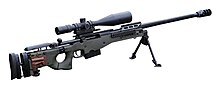
The AWM sniper rifle, a bolt-activity rifle
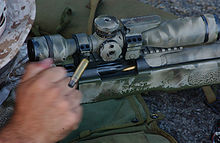
A Usa Marine extracts a fired cartridge from an M40A3 using a commodities-action mechanism
Commodities activeness is a blazon of manual firearm action that is operated past directly manipulating the bolt via a bolt handle, which is most commonly placed on the right-hand side of the weapon (equally most users are right-handed).
Most bolt-activeness firearms utilise a rotating bolt design, where the handle must starting time be rotated upward to unlock the bolt from the receiver, so pulled back to open the breech and allowing any spent cartridge case to exist extracted and ejected. This too cocks the striker within the commodities (either on opening or closing of the bolt depending on the gun design) and engages it against the sear. Upon the commodities being pushed back forward, a new cartridge (if available) is pushed out of the mag and into the barrel sleeping accommodation, and finally the breech is airtight tight by rotating the handle down and so the bolt head relocks on the receiver.
Bolt-action firearms are generally repeating firearms, but some single-shot breechloaders too use commodities-activeness design as a breechblock mechanism. The majority of these firearms are rifles, but there are some bolt-action variants of shotguns and handguns every bit well. Examples of these engagement as far back as the early 19th century, notably in the Dreyse needle gun. From the late 19th century all the manner through both Globe Wars, bolt-action rifles were the standard infantry service weapons for near of the world's armed services forces. In modern armed services and police force enforcement, bolt-action firearms have been mostly replaced by semi-automated and selective-fire firearms, and have remained prevalent only every bit sniper rifles due to the design's inherent potential for superior accuracy and precision, as well as ruggedness and reliability compared to autoloading designs.
History [edit]
The showtime bolt-action burglarize was produced in 1824 by Johann Nikolaus von Dreyse, following work on breechloading rifles that dated to the 18th century. Von Dreyse would perfect his Nadelgewehr (Needle Rifle) past 1836, and it was adopted by the Prussian Army in 1841. While it saw limited service in the German Revolutions of 1848, it was not fielded widely until the 1864 victory over Denmark.[1] In 1850 a metal centerfire bolt-action breechloader was patented by Béatus Beringer.[2] In 1852 another metallic centerfire bolt-action breechloader was patented by Joseph Needham and improved upon in 1862 with another patent.[three] [4] [5] 2 different systems for primers –the mechanism to ignite a metallic cartridge'due south pulverisation charge – were invented in the 1860s as well, the Berdan[6] and the Boxer[7] systems.
The U.s.a. purchased 900 Greene rifles (an under hammer, percussion capped, single-shot bolt action that used paper cartridges and an ogivial bore rifling system) in 1857, which saw service at the Battle of Antietam in 1862, during the American Civil State of war;[8] withal, this weapon was ultimately considered also complicated for issue to soldiers, and was supplanted past the Springfield Model 1861, a conventional muzzle loading rifle. During the American Ceremonious State of war, the bolt-activity Palmer carbine was patented in 1863, and by 1865, 1000 were purchased for utilise every bit cavalry weapons. The French Army adopted its showtime bolt-activeness rifle, the Chassepot rifle, in 1866 and followed with the metallic cartridge bolt-action Gras rifle in 1874.
European armies continued to develop bolt-activity rifles through the latter half of the 19th century, first adopting tubular magazines as on the Kropatschek burglarize and the Lebel rifle. The offset bolt-action repeating rifle was patented in United kingdom in 1855 by an unidentified inventor through the patent agent Auguste Edouard Loradoux Bellford using a gravity operated tubular magazine in the stock.[nine] Another more than well known bolt-action repeating burglarize was the Vetterli rifle of 1867 and the showtime commodities-activeness repeating rifle to utilize centerfire cartridges was the weapon designed by the Viennese gunsmith Ferdinand Fruwirth in 1871.[10] Ultimately, the military turned to bolt-activeness rifles using a box magazine; the kickoff of its kind was the M1885 Remington–Lee, but the first to exist generally adopted was the British 1888 Lee–Metford. World State of war I marked the height of the bolt-action burglarize's use, with all of the nations in that state of war fielding troops armed with various commodities-action designs.
During the buildup prior to World War II, the military bolt-action rifle began to be superseded past semi-automated rifles and after fully automatic rifles, though bolt-action rifles remained the chief weapon of virtually of the combatants for the duration of the state of war; and many American units, especially USMC, used bolt-activity '03 Springfields until sufficient M1 Garands were available. The bolt action is still common today among sniper rifles, equally the design has potential for superior accuracy, reliability, bottom weight, and the ability to control loading over the faster rate of burn that alternatives allow. There are, nonetheless, many semi-automated sniper burglarize designs, especially in the designated marksman office.
Today, bolt-activeness rifles are chiefly used every bit hunting rifles. These rifles tin be used to hunt anything from vermin to deer and to large game, especially big game caught on a safari, as they are adequate to evangelize a unmarried lethal shot from a safety altitude.
Bolt-action shotguns are considered a rarity among modern firearms, but were formerly a commonly used action for .410 entry-level shotguns, as well as for depression-cost 12 gauge shotguns. The M26 Modular Accessory Shotgun Organization (MASS) is the most avant-garde and contempo instance of a bolt-activeness shotgun, admitting 1 designed to exist attached to an M16 burglarize or M4 carbine using an underbarrel mountain (although with the standalone kit, the MASS can become a standalone weapon). Mossberg 12 gauge commodities-activity shotguns were briefly popular in Commonwealth of australia after the 1997 changes to firearms laws, merely the shotguns themselves were awkward to operate and had simply a three-round magazine, thus offering no applied and real advantages over a conventional double-butt shotgun.
Some pistols use a bolt action, although this is uncommon, and such examples are typically specialized target handguns.
Major commodities-action systems [edit]
Rotating bolt [edit]
Virtually of the bolt-action designs use rotating commodities (or "turn pull") design, which involves the shooter doing an up "rotating" movement of the handle to unlock the bolt from the breech and cock the firing pin, followed past a rearward "pull" to open the breech, extract the spent cartridge case, then contrary the whole process to chamber the next cartridge and relock the breech. There are four major turn bolt-activity designs: the Remington Chiliad-700, peradventure the single nearly numerous produced rifle in history, the Mauser system, the Lee–Enfield system, and the Mosin–Nagant system. All four differ in the way the bolt fits into the receiver, how the bolt rotates as it is being operated, the number of locking lugs belongings the bolt in place equally the gun is fired, and whether the activeness is artsy on the opening of the bolt (as in both the Mauser organization and the Mosin Nagant arrangement) or the closing of the bolt (as in the Lee–Enfield system). The vast majority of modern bolt-action rifles were made for the commercial marketplace post war, numbering in the tens of millions past Remington in the unique, and most accurate Model 700, ii of the others use the Mauser system, with other designs such every bit the Lee–Enfield system and the Mosin Nagant organisation, of just limited usage.
Mauser [edit]
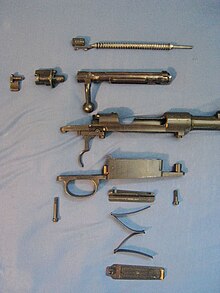
The Mauser commodities-activeness organisation is based on 19th-century Mauser bolt-action burglarize designs and was finalized in the Gewehr 98 designed by Paul Mauser. It is the virtually common bolt-action system in the world,[ citation needed ] being in apply in well-nigh all modernistic hunting rifles and the bulk of military bolt-action rifles until the center of the 20th century. The Mauser system is stronger than that of the Lee–Enfield due to ii locking lugs just behind the bolt head, which brand information technology ameliorate able to handle higher-pressure level cartridges (i.e. magnum cartridges). The 8×68mm S and 9.3×64mm Brenneke magnum rifle cartridge "families" were designed for the Mauser Grand 98 bolt action. A novel condom feature was the introduction of a third locking lug present at the rear of the bolt that commonly did not lock the commodities, since it would introduce asymmetrical locking forces. The Mauser arrangement features "erect on opening", significant the upwardly rotation of the commodities when the rifle is opened cocks the action. A drawback of the Mauser M 98 system is that information technology cannot be cheaply mass-produced very easily.[ citation needed ] Many Mauser M 98-inspired derivatives feature technical alterations, such every bit omitting the third prophylactic locking lug, to simplify production.
The controlled-feed Mauser Thou 98 bolt-action organisation's uncomplicated, strong, safe, and well-thought-out design inspired other military and hunting/sporting burglarize designs that became available during the 20th century, including the:
- Gewehr 98/Karabiner 98k
- M24 series
- vz. 24/vz. 33
- Type 24 rifle
- M1903 Springfield
- Pattern 1914 Enfield
- M1917 Enfield
- Arisaka Type 38/Blazon 99
- M48 Mauser
- Kb wz. 98a/Karabinek wz. 1929
- FR8
- modern hunting/sporting rifles like the CZ 550, Heym Express Magnum, Winchester Model 70 and the Mauser M 98
- modern sniper rifles like the Sako TRG, Accuracy International Arctic Warfare and GOL Sniper Magnum
Versions of the Mauser action designed prior to the Gewehr 98's introduction, such as that of the Swedish Mauser rifles and carbines, lack the 3rd locking lug and feature a "cock on closing" performance.
Lee–Enfield [edit]
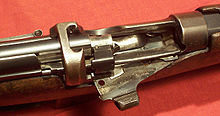
Shut-up of the activity on an SMLE Mk 3 burglarize, showing the bolt head, magazine cutting off, and charger prune guide.
The Lee–Enfield bolt-action organization was introduced in 1889 with the Lee–Metford and after Lee–Enfield rifles (the bolt system is named afterwards the designer James Paris Lee and the barrel rifling after the Royal Small Arms Manufactory at the London Borough of Enfield), and is a "cock on endmost" action in which the frontward thrust of the commodities cocks the action. This enables a shooter to go along eyes on sights and target uninterrupted past cycling the bolt. The power of the bolt betwixt lugs and chamber to flex also keeps the shooter safer in example of catastrophic chamber over pressure. The disadvantage of the rearward located bolt lugs is that a larger role of the receiver, between chamber and lugs, must be made stronger and heavier to resist stretching forces. Also, the bolt ahead of the lugs may flex on firing which, although a safety advantage, may eventually atomic number 82 to increased head space. Repeated firing over time tin can lead to receiver "stretch" and excessive headspace, which if perceived as a problem can be remedied by changing the removable bolt caput to a larger sized one (the Lee–Enfield bolt manufacture involved a mass production method where at final assembly the bolt body was fitted with i of three standard size bolt heads for correct headspace). In the years leading up to WWII, the Lee–Enfield bolt system was used in numerous commercial sporting and hunting rifles manufactured by such firms in the UK as BSA, LSA, and Parker–Unhurt, besides equally by SAF Lithgow in Australia. Vast numbers of ex military SMLE Mk III rifles were sporterised post WWII to create cheap, effective hunting rifles, and the Lee–Enfield commodities system is used in the M10 and No 4 Mk Iv rifles manufactured by Australian International Artillery. Rifle Mill Ishapore of India articles a hunting and sporting burglarize chambered in .315 which likewise employs the Lee Enfield action.[11]
- Lee–Enfield (all marks and models)
- Ishapore 2A1
- Various hunting/sporting rifles manufactured by BSA, LSA, SAF Lithgow, and Parker Unhurt
- Australian International Arms M10 and No iv Mk Iv hunting/sporting rifles
- Rifle Factory Ishapore's hunting Lee Enfield rifle in .315
Mosin–Nagant [edit]
The Mosin–Nagant action, created in 1891 and named later the designers Sergei Mosin and Léon Nagant, differs significantly from the Mauser and Lee–Enfield bolt-action designs. The Mosin–Nagant design has a separate bolthead which rotates with the commodities and the bearing lugs, in contrast to the Mauser organisation where the bolthead is a non-removable part of the bolt. The Mosin–Nagant is also unlike the Lee–Enfield arrangement where the bolthead remains stationary and the bolt body itself rotates. The Mosin–Nagant commodities is a somewhat complicated affair, but is extremely rugged and durable; like the Mauser, it uses a "cock on open" system. Although this bolt system has been rarely used in commercial sporting rifles (the Vostok brand target rifles being the virtually recognized) and never outside of Russia, large numbers of military surplus Mosin–Nagant rifles have been sporterized for apply as hunting rifles in the years since WWII.
Other designs [edit]
Both the U.S. Army's M24 Sniper Weapon System and U.S. Marine Corps' M40 sniper rifles are built from the Remington Model 700 burglarize, in different degrees of modification, the chief deviation existence the custom fitted heavy profile barrel and activity length. The M24 utilizes the Long action and the M40 employs the brusque action commodities-face. The reason for this is that the M24 was originally intended to chamber the longer .300 Winchester Magnum round. The M40, yet, was not intended to be chambered in the more powerful .300 Winchester Magnum round, yet the Marine Corps' intention was to migrate to the .300 Winchester Magnum cartridge. The Marine Corps' delay has led to a change in migratory direction, the current goal is for the M40 to become a burglarize chambered in .338 Lapua Magnum.[12]
The United States Army's Joint Munitions and Lethality Contracting Center has awarded Remington a Business firm Fixed Price (FFP) Indefinite Delivery/ Indefinite Quantity (ID/IQ) contract (W15QKN-ten-R-0403) for the upgrade of upwardly to iii,600 M24 Sniper Weapon Systems (SWS) currently fielded to the Army pending type classification as the "M24E1". The major configuration change for this arrangement is the caliber conversion from 7.62mm NATO (.308 Winchester) to .300 Winchester Magnum to provide soldiers with additional precision engagement adequacy and range. The contract is for a five-year period and has guaranteed minimum value of $192K with a potential value of up to $28.ii meg.[13] This honor follows a full and open competitive evaluation lasting nine months, which began with the release of the Army'southward Request for Proposal (RFP) on Jan 13, 2022. The program will be executed under the authorization of Project Manager Soldier Weapons, Picatinny Arsenal, NJ, and managed by its subordinate unit, Product Manager Private Weapons. In 2009 the U.S. Army has changed the weapon proper noun from M24E1 to the XM2010 Enhanced Sniper Rifle.[14]
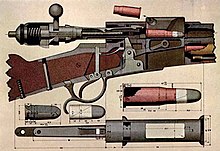
Cutaway diagram of the Vetterli burglarize's action.
The Vetterli burglarize was the first bolt-activity repeating rifle introduced by an army. It was used past the Swiss army from 1869 to circa 1890. Modified Vetterlis were also used past the Italian Ground forces. Another notable design is the Norwegian Krag–Jørgensen, which was used by Kingdom of norway, Kingdom of denmark, and briefly the The states. It is unusual among bolt-action rifles in that is loaded through a gate on right side of the receiver, and thus can be reloaded without opening the commodities. The Norwegian and Danish versions of the Krag have two locking lugs, while the American version has only one. In all versions, the bolt handle itself serves as an emergency locking lug. The Krag's major disadvantage compared to other commodities-action designs is that information technology is usually loaded by hand, i circular at a time, although a box like device was made that could driblet five rounds into the magazine, all at once via a stripper or en bloc clip. This made information technology slower to reload than other designs which used stripper or en bloc clips. Some other historically important bolt-action arrangement was the Gras arrangement, used on the French Mle 1874 Gras burglarize, Mle 1886 Lebel rifle (which was get-go to introduce ammunition loaded with nitrocellulose-based smokeless powder), and the Berthier serial of rifles.
Directly pull [edit]
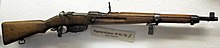


Heym SR thirty (1998), straight pull activity. Lock up is achieved by 6 ball bearings around the circumference of the bolt head. This mechanism was originally developed for biathlon rifles.

Straight-pull bolt actions differ from a conventional turn-pull bolt-action mechanisms in that the commodities tin be cycled dorsum and frontward without rotating the handle and thus only a linear motion is required, equally opposed to a traditional bolt action, where the user has to axially rotate the bolt in addition to the linear motions to perform chambering and primary extraction. The bolt locking of a straight pull action is achieved differently without needing manual inputs, therefore the entire operating bike needs the shooter to perform only two movements (pull back + push button forward) instead of four (rotate up + pull back + push forrad + rotate downward), greatly increasing the gun'southward rate of fire.
In 1993 the German Blaser visitor introduced the Blaser R93, a new straight pull action where locking is achieved by a series of concentric "claws" that protrude/retract from the bolthead, a design that is referred to every bit Radialbundverschluss ("radial connectedness"). As of 2022 the Rifle Shooter magazine[fifteen] listed its successor Blaser R8 as 1 of the three most popular straight pull rifles together with Merkel Helix and Browning Maral.[16] Some other notable modern direct pull rifles are made by Beretta,[17] C.G. Haenel,[18] Chapuis,[19] Heym,[20] Lynx,[21] Rößler,[22] Vicious Arms,[23] Strasser,[24] and Steel Action.[25]
Most straight bolt rifles have a firing mechanism without a hammer,[ citation needed ] merely at that place are some hammer fired models, such as the Merkel Helix. Firearms using a hammer normally have a comparably longer lock time than hammerless mechanisms.
In the sport of biathlon, because shooting speed is an important performance factor and semi automatic guns are illegal for race utilise, directly pull deportment are quite mutual, and are used almost exclusively on the Biathlon Earth Cup. The kickoff company to make the straight pull action for .22 caliber was J. Grand. Anschütz; the action is specifically the straight pull ball bearing lock action, which features spring loaded ball bearings on the side of the commodities which lock into a groove inside the bolt's housing. With the new blueprint came a new dry burn down method; instead of the bolt being turned up slightly, the action is locked back to catch the firing pivot.
Operating the commodities [edit]
Typically, the commodities consists of a tube of metal within of which the firing machinery is housed, and which has at the forepart or rear of the tube several metal knobs, or "lugs", which serve to lock the bolt in place. The operation can be done via a rotating bolt, a lever, cam action, locking piece, or a number of systems. Direct pull designs have seen a bang-up deal of employ, though manual turn bolt designs are what is about commonly thought of in reference to a bolt-activity blueprint due to the type ubiquity. As a result, the commodities activity term is oft reserved for more than modern types of rotating bolt designs when talking nearly a specific weapon's blazon of activeness. Nevertheless, both straight pull and rotating commodities rifles are types of bolt-action rifles. Lever-action and pump-activity weapons must still operate the bolt, simply they are usually grouped separately from bolt actions that are operated by a handle straight attached to a rotating bolt. Early bolt-activeness designs, such equally the Dreyse needle gun and the Mauser Model 1871, locked past dropping the bolt handle or bolt guide rib into a notch in the receiver, this method is withal used in .22 rimfire rifles. The most mutual locking method is a rotating bolt with two lugs on the commodities caput, which was used by the Lebel Model 1886 rifle, Model 1888 Committee Rifle, Mauser M 98, Mosin–Nagant and most bolt-action rifles. The Lee–Enfield has a lug and guide rib, which lock on the rear stop of the bolt into the receiver.
Bolt knob [edit]
The bolt knob is the part of the bolt handle which the user grips when loading and reloading the firearm, and thereby acts as a cocking handle. On many older firearms, the bolt knob is welded to the bolt handle, and equally such becoming an integral part of the bolt handle itself. On many newer firearms, the bolt knob is instead threaded onto the handle, allowing the user to alter the original bolt knob for an aftermarket 1, either for aesthetical reasons, achieving better grip or like.[26] The type of threads used vary between firearms. European firearms oft utilise either M6 one or M8 one.25 threads, for case M6 is used on the SIG Sauer 200 STR, Blaser R93, Blaser R8, CZ 457[27] and Bergara rifles,[27] while M8 is used on the Sako TRG and SIG Sauer 404. Many American firearms instead apply 1/four" 28 TPI (half-dozen.35 0.907 mm) or 5/16" 24 TPI (7.9375 one.058 mm) threads. Some other thread types are also used, for example No. 10 32 TPI (4.826 0.794 mm) as used by Mausingfield.[27] There also exists aftermarket slip on bolt handle covers which are mounted without having to remove the existing commodities handle.[28] These are frequently fabricated of either rubber or plastic.
Reloading [edit]
Well-nigh bolt-action firearms are fed past an internal magazine loaded by mitt, past en bloc, or stripper clips, though a number of designs have had a detachable magazine or independent magazine, or even no magazine at all, thus requiring that each circular be independently loaded. Generally, the magazine capacity is limited to between ii and x rounds, every bit it can permit the magazine to be flush with the bottom of the rifle, reduce the weight, or prevent mud and dirt from inbound. A number of bolt actions take a tube mag, such as along the length of the barrel. In weapons other than large rifles, such as pistols and cannons, there were some manually operated breech loading weapons. Even so, the Dreyse Needle burn rifle was the first breech loader to use a rotating bolt blueprint. Johann Nicholas von Dreyse's rifle of 1838 was accepted into service by Prussia in 1841, which was in plough developed into the Prussian Model 1849. The design was a single shot breech loader, and had the at present familiar arm sticking out from the side of the bolt, to turn and open the chamber. The entire reloading sequence was a more complex process than afterward designs, however, as the firing pin had to be independently primed and activated, and the lever was used just to motility the bolt.
See also [edit]
- Antique guns
- British military rifles
- Service rifle
- Indonesia military machine rifles
Some notable bolt-activity rifles [edit]
- Arctic Warfare series
- Arisaka
- Berthier burglarize
- Browning A Bolt
- Carcano
- K31
- Krag–Jørgensen
- Lebel rifle
- M1903 Springfield rifle
- M1917 Enfield rifle
- Mannlicher–Schönauer
- MAS 36
- Mosin–Nagant
- Remington 700
- Ruger M77
- Winchester Model lxx
Other firearm actions [edit]
- Break action
- Falling cake action
- Lever activeness
- Pump action
- Rolling block
- Rotating bolt
- Semi automatic burglarize
- Blowback (arms)
- Gas operated
- Recoil operation
- Automated burglarize
References [edit]
- ^ Dupuy, Trevor N., Colonel, U.S. Army (rtd). Evolution of Weapons and Warfare (Indianapolis: Bobbs-Merrill, 1980), p. 293.
- ^ Description des machines et procedes specifies dans les brevets d'invention, de perfectionnement et d'importation, dont la duree est expirée ... (in French). Bouchard-Huzard. 1855.
- ^ Office, Great Britain Patent (1859). Abridgments of the Specifications Relating to Fire-arms and Other Weapons, Ammunition, and Accoutrements: A.D. 1588–1858]-Pt. Ii. A.D. 1858–1866. George Eastward. Eyre and William Spottiswoode, pub. at the Great seal patent office.
- ^ English language Patents of Inventions, Specifications: 1862, 1522 – 1600. H.K. Stationery Office. 1862.
- ^ Howard Fifty. Blackmore. "Guns and Rifles of the World" (London: Chancellor Press, 1965), p. 69.
- ^ Mast, Gregory (2007). To be a armed services sniper. Zenith Press. p. 48. ISBN978-i-61060-032-three. OCLC 847527424.
- ^ Heard, Brian J. (xv September 2022), "Firearms: History", Wiley Encyclopedia of Forensic Science, Chichester, United kingdom: John Wiley & Sons, Ltd, doi:x.1002/9780470061589.fsa1022, ISBN978-0-470-06158-nine , retrieved 3 April 2022
- ^ "NRA Museums".
- ^ "English Patents of Inventions, Specifications: 1855, 1419 – 1481". 1856.
- ^ Firearms Past and Present: Jaroslav Lugs, p. 147.
- ^ ".315" Sporting Burglarize". rfi.gov.in . Retrieved 12 April 2022.
- ^ "M24 Sniper Rifle". Military.com. Archived from the original on Nov 15, 2022. Retrieved August 10, 2022.
- ^ "10--M24 Sniper Weapon Organization Reconfiguration".
- ^ Lance M. Salary (30 April 2022). "Improved carbines headed your way". Regular army Times.
- ^ Holtam, Dominic (x March 2022). "Straight pull rifles". Burglarize Shooter . Retrieved 12 Apr 2022.
- ^ Browning Maral "Gun Mart Review". Gun Mart . Retrieved 12 April 2022.
- ^ Beretta introduces the BRX1 hunting straight-pull repeater
- ^ Premiere at Haenel: the new Jaeger NXT directly-pull repeater
- ^ "Chapuis Armes "ROLS": New Directly Pull Bolt Activeness Rifle –". The Firearm Blog. 11 April 2022. Retrieved 12 Apr 2022.
- ^ U.k., Shooting (xiii Dec 2022). "Heym SR30 direct-pull rifle review review". Shooting UK . Retrieved 12 April 2022.
- ^ "Lynx 94 Review". Sporting Burglarize magazine. 18 July 2022. Retrieved 12 April 2022.
- ^ Potts, Bruce (16 December 2022). "Titan 16 straight-pull rifle review". Shooting United kingdom of great britain and northern ireland . Retrieved 12 April 2022.
- ^ Brand new 2022: Savage Impulse, the new straight-pull rifle from the USA
- ^ Potts, Bruce (2 November 2022). "Strasser RS Solo review". Shooting Great britain . Retrieved 12 April 2022.
- ^ H, Hrachya (vii June 2022). "German Straight Pull Bolt Action Rifles by Steel Action –". The Firearm Weblog . Retrieved 12 Apr 2022.
- ^ "Get a Handle on It". Shooting Illustrated. 17 Baronial 2022. Retrieved 12 Apr 2022.
- ^ a b c "419 Commodities Knobs – Surface area 419". Area 419 – Precision Comes Standard. 29 September 2022. Retrieved 12 April 2022.
- ^ Pandemic, Major (18 October 2022). "Review: KRG Remington Action Bolt Lift Oversized Commodities Handle Knob". AllOutdoor.com . Retrieved 12 April 2022.
Further reading [edit]
- Zwoll, Wayne (2003). Bolt Action Rifles. Krause Publications. ISBN978-0-87349-660-5.
External links [edit]
 Media related to Commodities activity (firearms) at Wikimedia Commons

Source: https://en.wikipedia.org/wiki/Bolt_action
Posted by: diazcipen1977.blogspot.com
0 Response to "How To Clean A Browning A-bolt Action Shotgun"
Post a Comment